
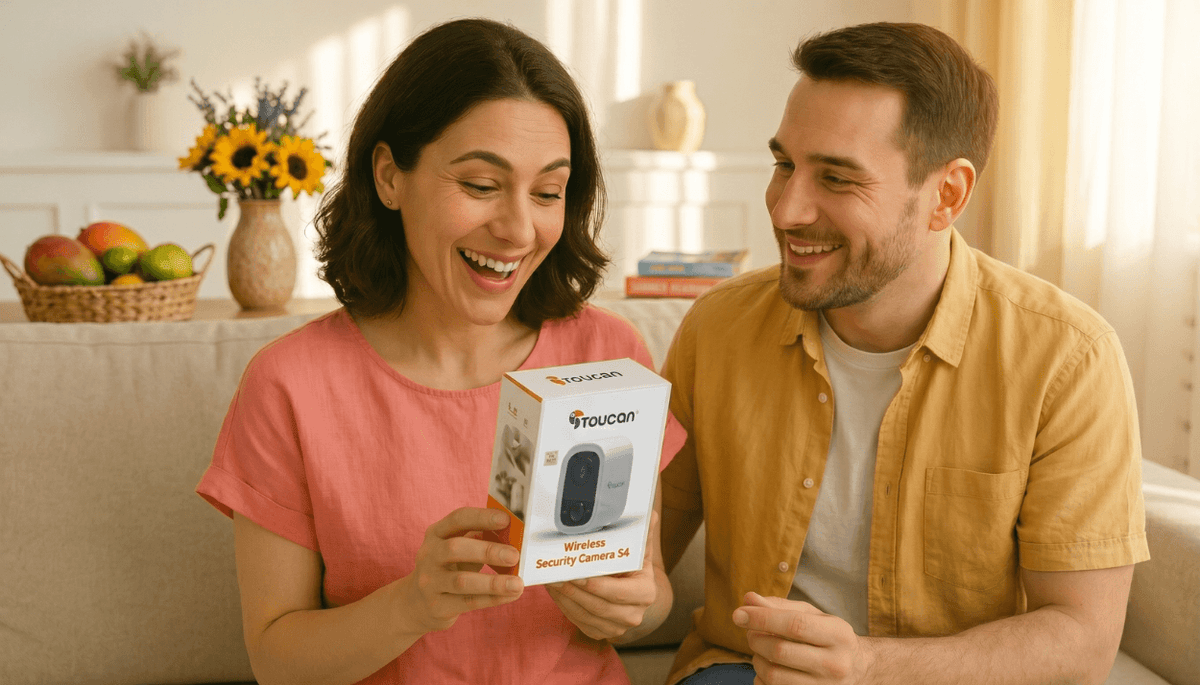
A Friendly Guide to PIR, Two-Way Audio, and Solar Power
Modern families look for ways to protect their properties with minimal stress. A wireless home security camera provides a convenient way to monitor porches and yards using a smartphone. These gadgets remove the requirement for complex wiring or professional installers.
While the setup process is easier than ever, the technical language on the packaging can still feel overwhelming. This guide breaks down the core terms so everyone can make an informed choice for their home safety.

Smart Home Labels Explained
Reading the technical specifications on a Toucan box helps homeowners understand exactly what their new device can do. For seniors and first-time users, knowing these terms builds confidence during the installation process. Most modern systems focus on wireless connectivity and solar-powered designs to keep things simple.
A wireless home security camera uses your home Wi-Fi to send video to your phone, while solar-powered models use a small panel to gather energy from the sun. Understanding how these features interact ensures that the camera stays active and alert without constant maintenance.
|
Feature |
Technical Definition |
Homeowner Benefit |
|
PIR Sensor |
Passive Infrared heat detection |
Blocks false alarms from moving trees or shadows. |
|
Two-Way Audio |
Simultaneous or alternating voice paths |
Allows you to talk to visitors through your phone. |
|
Solar Charging |
Photovoltaic energy conversion |
Keeps the battery full using natural sunlight. |
|
2.4 GHz Wi-Fi |
Most devices can work in standard Wi-Fo 4 or 5 |
Provides a more stable connection and faster video. |
|
IP56 Rating |
Professional weatherproofing standard |
Protects the camera from heavy rain and dust. |
PIR Motion Sensors: The Heat-Seeking Bodyguards

One of the most important parts of a wireless home security camera is the motion sensor. Many people assume that cameras record every time something moves in the frame. However, traditional cameras that rely on pixel changes often trigger alerts for non-threatening things like a passing cloud or a blowing leaf. This is where Passive Infrared (PIR) technology provides a better solution.
How does a PIR sensor work?
PIR sensors do not actually "see" a picture like a lens does. Instead, they detect the infrared radiation that every warm object emits. Humans and animals have a specific heat signature that stands out from the cold background of a wall or a driveway. The sensor remains in a passive state until it notices a sudden change in heat moving across its field of vision. When a person walks into the detection zone, their body heat triggers the electronics to wake up the camera and start recording.
Why do Fresnel lenses matter?
If you look closely at a PIR sensor, you will notice a plastic cover with tiny ridges or bumps. This is a Fresnel lens. It acts like a magnifying glass that focuses infrared light onto the sensor. These lenses are designed with multiple zones or "segments." As a person moves, they pass from one zone to another. This movement across the segments creates a pulse that the camera interprets as a moving person. This design is highly effective because it helps the camera ignore steady heat sources like a warm brick wall.
Temperature sensitivity and placement
Studies show that PIR sensors are responsible for reducing false alarms by over 90% in residential areas. However, ambient temperature can affect how they work. During a very hot summer day, the temperature of the air might be close to the temperature of a human body. In these rare cases, the sensor has to work harder to tell the difference between the person and the air. Placing your camera in a spot that gets a bit of shade can help the sensor stay accurate. Proper placement ensures that the heat-seeking "eyes" of your camera are always ready to spot an intruder.
Two-Way Audio: Your Digital Walkie-Talkie

Communication is a key part of modern home security. Two-way audio allows you to hear what is happening outside and speak back through the camera speaker. This feature is useful for telling a delivery driver where to leave a package or asking a neighbor why they are at your door.
Half-duplex versus Full-duplex
There are two main ways that cameras handle audio. Half-duplex systems work like a traditional walkie-talkie. You have to press a button on your phone to talk and then release it to hear the person on the other side. You cannot both speak at the exact same time. Full-duplex systems are more advanced. They work like a phone call, allowing both people to talk and listen simultaneously.
Latency and sound quality
Latency refers to the delay between when a person speaks and when the other person hears them. This delay is often caused by the time it takes to compress the audio and send it over the internet. Professional-grade cameras use specific software to keep this delay under 200 milliseconds. This ensures that the conversation flows smoothly without long silences. Good cameras also include noise suppression. This technology filters out the sound of wind or traffic so you can hear a visitor's voice clearly.
Usage cases for audio
How can you use this feature daily? Imagine you are at the grocery store and see a delivery person on your phone. You can tell them to hide the box behind a planter. If you see a pet playing in a garden they shouldn't be in, you can give them a quick command to stop. In some situations, simply letting a visitor know you are watching is enough to keep your porch safe.
Solar Charging: Perpetual Energy from Above

The biggest worry for many homeowners is the battery life of their devices. A wireless home security camera needs a power source to stay active. Solar charging has become the preferred solution because it removes the need to take the camera down for recharging.
How much sun do you really need?
Solar technology has improved significantly in recent years. Today, standard security camera solar panels only need about three to four hours of direct sunlight to provide enough power for a full day of use. These panels are typically rated between 5 watts and 15 watts. A higher wattage panel charges the battery faster, which is great for cameras that record a lot of activity.
The benefits of wireless and solar
Combining wireless connectivity with solar power creates a truly independent security system. You can mount these cameras on a fence post, a shed, or a tree at the edge of your property. As long as the solar panel can see the sky and the camera can reach your Wi-Fi, the system is self-sufficient. This flexibility is perfect for renters who cannot drill holes for permanent power lines.
Maintenance and performance
Solar panels are very durable, but they do need a little bit of care. Dust, pollen, or snow can settle on the glass and block the sunlight. Giving the panel a quick wipe with a damp cloth every few months keeps the energy flowing. Modern battery management systems also protect the internal battery from extreme cold or heat. This ensures that your camera lasts for many years without needing a replacement part.
Frequently Asked Questions
Q: Does the camera work at night if there is no sun?
A: Yes. The solar panel charges an internal battery during the day. This battery stores enough energy to keep the camera running through the night and even through several cloudy days. Most batteries are designed to last for weeks on a single charge, so a little bit of rain won't turn your security off.
Q: Will the PIR sensor detect my cat or dog?
A: Most PIR sensors have a sensitivity setting. You can adjust the camera so it ignores small pets while still detecting adult humans. This helps prevent your phone from buzzing every time a squirrel runs through the yard.
Q: How far away can the camera hear a person?
A: Most high-quality camera microphones can pick up clear voices from about 10 to 15 feet away. If the area is very quiet, the camera might even hear sounds from further away. Mounting the camera near the eye level of a visitor provides the best audio results.
Q: Can I use solar panels in the winter?
A: Yes. Solar panels still produce electricity on cold, sunny days. In fact, cold temperatures can sometimes make solar cells work more efficiently. As long as you keep the snow off the panel, it will continue to provide power to your camera.
Q: Is the video quality lower on a solar camera?
A: No. Modern solar-powered cameras offer the same high-definition video as wired versions. High resolutions like 2K or 4K are common today, providing crystal clear images of faces and license plates.
Q: How much data does the two-way audio use?
A: Audio uses very little data compared to video. Speaking through your camera is similar to making a quick voice call on an app. It will not have a large impact on your home data plan.
Q: Is it hard to install a solar panel?
A: Installing the panel is usually a very simple task. Most kits come with a small bracket and a few screws. You just need to point the panel toward the south (if you live in the US) to get the most sunlight throughout the day. A single cable then plugs from the panel into the back of the camera.
Final Thoughts
The world of home security is moving toward smarter and simpler solutions. Features like PIR motion sensors, two-way audio, and solar charging are designed to give homeowners peace of mind without requiring a degree in engineering. A wireless home security camera that handles its own power and filters out false alerts is a reliable partner for any household.
Understand these basic terms soyou can select the technology that best fits your lifestyle. Protecting your home is now as easy as checking your phone and letting the sun do the heavy lifting.

Share:
Bundles vs. Single Cameras: What’s The Best Home Protection
Toucan AI+: Smarter Home Security Without Making Life Complicated